
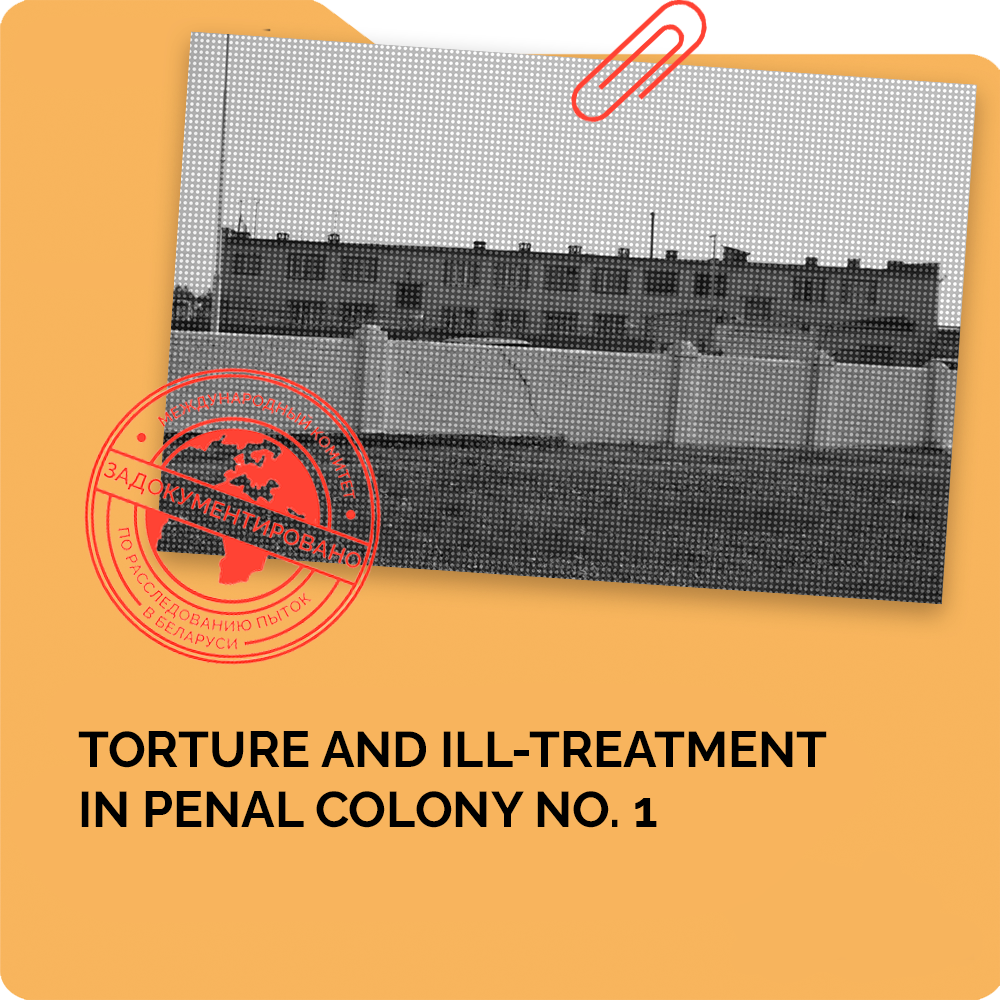
The International Committee for the Investigation of Torture in Belarus has published a new public investigation about what is happening behind the walls of Penal Colony No. 1 in Navapolatsk.
A Conveyor Belt of Torture
Penal Colony No. 1 in Navapolatsk is notorious as one of the most brutal prisons in Belarus. It is located in a remote industrial area, surrounded on all sides by chemical plants. Even the environment itself seems hostile to human life: the air constantly smells of chemicals, and the water is dirty and technical. Nevertheless, for years the authorities have been sending there those they wish to punish especially harshly.
Since 2020, hundreds of political prisoners – people convicted on fabricated political charges — have ended up there. Among them are some of the most prominent opponents of Alyaksandr Lukashenka. The colony holds the 2020 presidential candidate Viktar Babaryka [released and deported from Belarus in December 2025], journalist and leader of the Polish minority Andrzej Poczobut, media manager Andrei Aliaksandrau, as well as activists, businesspeople, academics, former law enforcement officers, and anyone who dared to oppose or speak out against the regime.
«This is a concentration camp — the concentration of political prisoners there is very high, about thirty percent», – testifies a former political prisoner of Colony No. 1. The colony has effectively become a site of reprisal against those whom the regime considers its personal enemies.
«He told the head of the colony: «You won’t break me.” He replied: «I won’t break you? Well, let’s see,” – and ordered him to be laid out on a table. They held his arms, and the head of the colony personally beat the man until he started bleeding from the rectum.
This is how former prisoners describe the “educational methods” used in Navapolatsk Penal Colony No. 1. This case is only one element of a system of mass torture and abuse. Political prisoners suffer the most. Their life in the Colony is turned into continuous torment — from the first day until the very last minute of their sentence.
A Special Regime for «Political» Prisoners
The colony administration behaves as if it has received an unofficial order: to create unbearable conditions for those deemed disloyal to the regime and to completely block their contact with the outside world.
Even everyday life in the colony becomes an extension of torture. The daily schedule is designed to exhaust prisoners to the limit, leaving them no moment of rest.
The work regime in Colony No. 1 is a separate source of suffering. Political prisoners are almost always assigned the heaviest and dirtiest jobs. In addition, they are often forced to work a sixth day — Saturdays — and sometimes even on public holidays. The goal is obvious: to physically overload a person as much as possible so that they have neither the strength nor the time to think about their rights.
Former political prisoners report that they were deprived even of legally mandated breaks. For example, instead of lunch breaks, they could be sent to additional work.
In Colony No. 1, political prisoners are not simply held together with ordinary criminal inmates — they are under special scrutiny by the administration. An informal special regime has been created for them within the colony.
«Beat Your Own»: Provocations and Informing
To maintain this monstrous regime, the administration relies on a classic “divide and rule” tactic. Prisoners are pitted against one another, informing is cultivated, and those who help suppress others are rewarded.
It is well known that Belarusian prisons rely on unofficial helpers of the administration — so-called “activists,” or simply “goats” (as prisoners contemptuously call them). In Colony No. 1, members of this “active” group are openly delegated some functions of guards. For example, squad leaders monitor prisoners around the clock and report every step to operational officers. Many of them are outright abusers whose specific mission is to extract “extra” information from prisoners and write denunciations. The administration also actively uses provocations.
«You can get a violation very easily. They’ll give you a violation for anything — didn’t say hello, a button isn’t fastened… Even if you did say hello, it doesn’t matter. If they came to issue a violation, it means you already have it,», – says a former political prisoner. This phrase vividly illustrates the lawlessness of Colony No. 1: there is always a pretext for punishment, if there is the will.
A Conveyor of Violence
Physical violence is one of the pillars on which “order” in the Colony is built. Everyone is beaten: criminal inmates and political prisoners alike, young and old. But political prisoners suffer more often. While an ordinary inmate may sometimes be left alone, there is no mercy for the “disobedient”: they are beaten at every opportunity — and even without one.
Former prisoners share horrifying memories of torture in the showers. There is a separate shower room in the unit that staff have turned into a torture chamber.
«When I was in the cell-type premises (PKT), the screams from beatings could be heard even in the corridor. They practice beatings in the shower — beating people until they bleed. Why the shower? Because everything can then be washed away with a hose», – recalls a political prisoner. This testimony makes it clear that torture in the colony is systematic and carefully planned.
Even formal disciplinary procedures in Colony No. 1 turn into violence. According to former political prisoners, it was not enough for staff to punish someone with solitary confinement — they wanted to “educate” the disobedient person to the brink of death.
On the Edge of Life and Death
The suppression regime in Colony No. 1 is so brutal that every year it leads to irreversible consequences. Some manage to survive until release with severely damaged health; others never leave the colony alive. According to eyewitnesses, “one or two people die in the colony every year.” Some commit suicide, others die from illnesses that were left untreated. The administration, of course, tries to present everything as “natural causes” or suicides, hiding behind bureaucratic wording in official documents. But behind many of these tragedies are specific causes and specific people.
Who bears responsibility for this lawlessness in Navapolatsk Penal Colony No. 1? Formally, the head of the colony and his deputies. But behind them stands the entire vertical structure of the Department for the Execution of Punishments and the Belarusian security apparatus.
«No cop ever does something illegal on their own initiative — they’re afraid of each other. All of this happens when they are told to do it», , – notes a former political prisoner. In simple terms, colony staff are merely carrying out what they have been taught and what is unofficially approved from above.
By publishing this investigation, the International Committee for the Investigation of Torture in Belarus declares: Colony No. 1 is no longer a “black zone.” It is now an object of close attention by the media and international observers. Every testimony from former political prisoners is a contribution to the future accountability of those responsible.
For now, however, a real conveyor belt of torture continues to operate in the heart of Europe. Hundreds of innocent people have already become its victims. But thanks to their courage and public exposure, there is hope that this conveyor will sooner or later be stopped.
Our task is to speak the truth about Navapolatsk Penal Colony No. 1 — no matter how terrifying that truth may be.
Here you can download the full version of the investigation.