

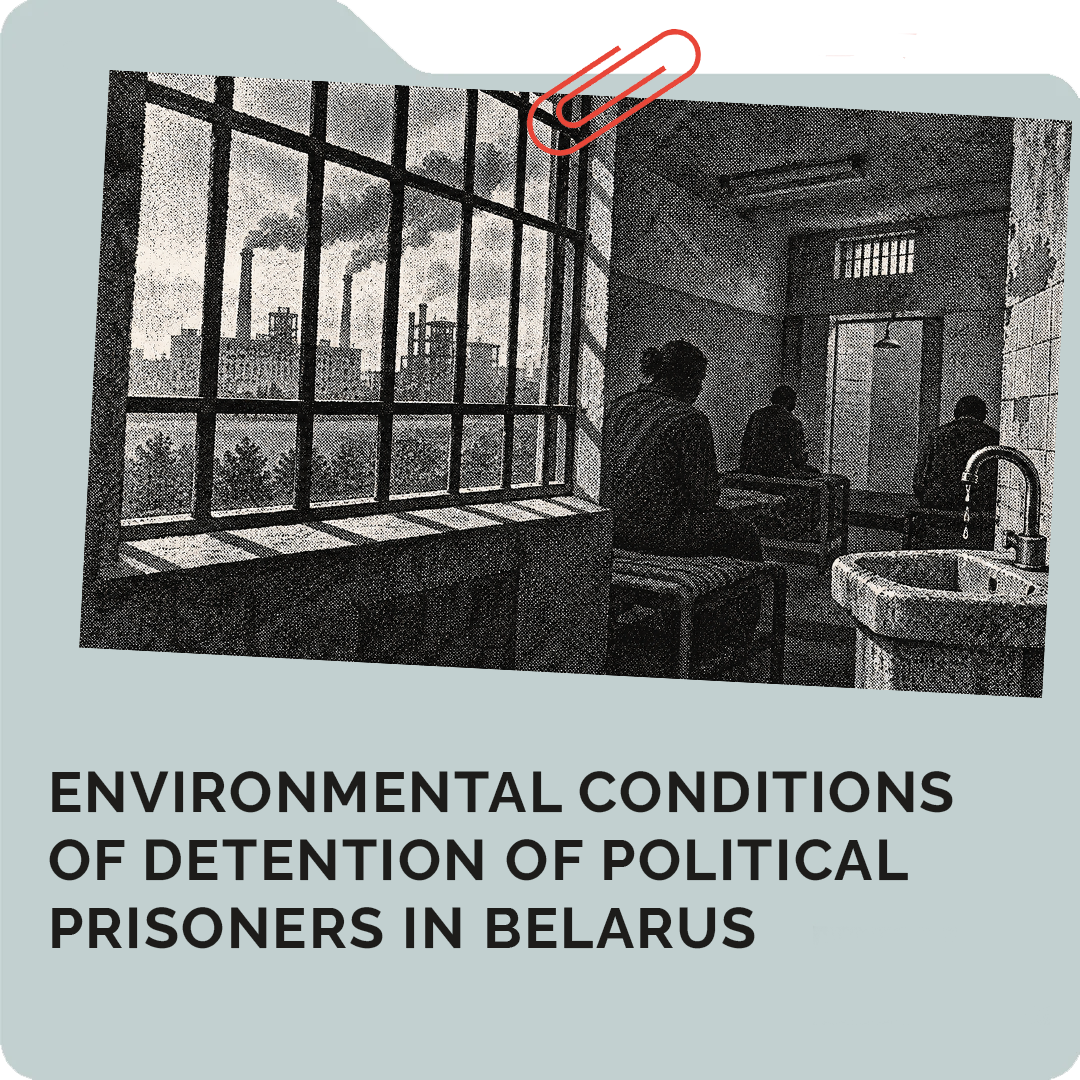
This report examines the environmental conditions in which political prisoners are held in Belarus and how these conditions can become a form of ill-treatment and pressure. In this context, we use the term “environmental torture” to describe situations in which extreme heat or cold, poor ventilation, lack of access to clean water and hygiene, unsanitary conditions, or other unsafe environmental factors do not simply result from poor infrastructure, but are used, or deliberately left unaddressed, in ways that cause suffering. We focus on this issue because environmental conditions in detention are rarely treated as a distinct human rights concern, even though people in prison have almost no ability to protect themselves from such risks.
The research focuses on two correctional colonies: the women’s Correctional Colony No. 4 in Gomel and the men’s Correctional Colony No. 1 in Novopolotsk. The report examines air and water quality, sanitation and access to hygiene, exposure to heat and cold, the condition of buildings and ventilation systems, the impact of these factors on health, and the institutions’ preparedness for extreme weather events.
The research is based on interviews with former political prisoners and is supplemented by reports from human rights organisations, international mechanisms, official statistics and other open sources. The documented conditions are compared with Belarusian legislation and international standards, including the Nelson Mandela Rules and recommendations of the International Committee of the Red Cross.
The findings show that some of the problems are linked to the general condition of the penitentiary system and ageing infrastructure. However, some testimonies point to another pattern: harmful environmental conditions may be used selectively against political prisoners. This includes exposure to extreme temperatures and restrictions on access to ventilation, water, hygiene products and medical care. In such cases, environmental conditions become an additional tool of pressure.
The report also identifies broader systemic problems: some technical regulations are not publicly available for independent scrutiny, certain important standards are absent altogether, and existing rules are not always followed in practice. The final section provides a legal assessment of the documented violations, recommendations for the state authorities of Belarus and international mechanisms, and areas for further research into environmental conditions in places of detention.
The full version can be downloaded HERE